
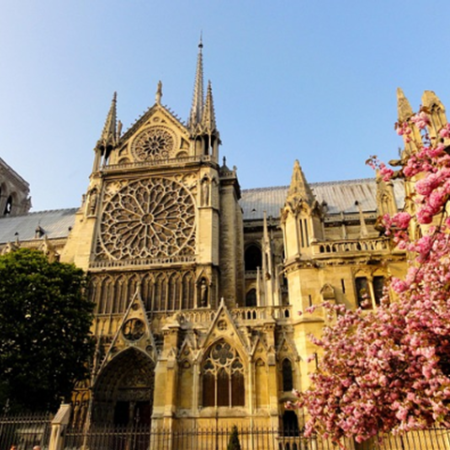
France is one of Europe’s most deliberately secular nations with a strict separation between church and state. There is significant suspicion towards the Church. The Church, after all, was part of the Ancien Régime, which the French Revolution swept away. In a sense, the Church is now the most visible, though severely weakened, sign of the old order, against which the modern republic has to be guarded.
And yet, France also recognises its Christian and ecclesial heritage. That was particularly evident in the response to the fire of the Cathedral of Notre-Dame de Paris. On 15 April 2019 the Cathedral caught fire destroying much of the roof. Immediately after the fire, French President Emmanuel Macron promised that Notre-Dame would be restored, and called for the work to be completed within five years. There was considerable controversy on the design of the renovations, with some advocating for a more contemporary rebuild, while others wanted a more traditional restoration. The arguments were settled relatively quickly with the French National Assembly passing a law on 19 July 2019 requiring that the restoration must preserve the historic, artistic and architectural interest of the monument.
Emmanuel Macron launched a national fundraising campaign, which was very successful, raising
€ 846 million, more than was required for the immediate restoration. The surplus funds of € 148 million would be used on further restoration and maintenance.
That stands in sharp contrast to the rebuild of the most famous cathedral in New Zealand, Christ Church Cathedral. Donations for the restoration of that cathedral have not been so forthcoming. While the government has provided some assistance, it has done so reluctantly and has never been that enthusiastic about the restoration. When the Minister of Finance turned down a request for further assistance she said: “The requested amount of at least $60m more would have been a significant contribution for a project that is not owned by the public, and where public use would be limited due to the cathedral being a private, religious space.” That reflects how much of the New Zealand sees the Cathedral—a private, religious space. In contrast, the French see their church buildings more as part of the social, historical and architectural fabric of the nation, even in their very secular approach to public affairs. Maybe we need to realise that New Zealand is now more secular than France and more suspicious of, and possibly even hostile to, the Christian Church.
Yes, it is true that the Anglican Church, being Protestant, is more concerned about God’s work among the people than fine buildings. And that is actually good. But at times that amplifies the secularism in our country. From an international perspective the attitude towards our Cathedral appears strange and narrow-minded.