
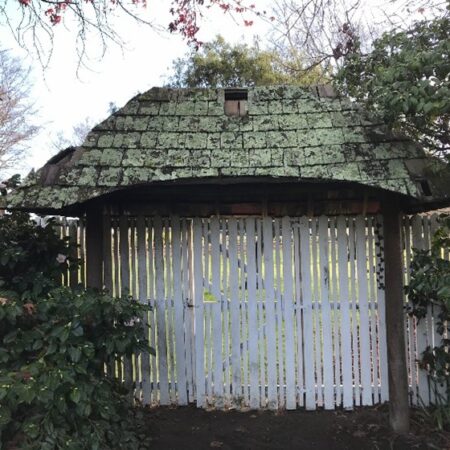
St Paul’s has a lych gate. It is located between the vicarage garden and the graveyard. It is only a very basic lych gate: it has the traditional wooden shingle roof and is incorporated into the fence, but does not really offer the shelter of a traditional lych gate. There are several more traditional lych gates associated with church in Christchurch. St Mary’s Addington has a nice lych gate, so do Holy Trinity Avonside and St Mary’s Halswell.
“Lych” or “lich” is the Old English word for “corpse”. Although gates to churchyards were quite common, it was the instruction in the 1549 Book of Common Prayer and its subsequent editions that specified that the pries should meet the Corpse at the church style that made covered gates more common. To provide some shelter for the those carrying the body, roofed gates became common. Lych gates either have a ‘porch’ roof, where the ridge corresponds to the passageway beneath, or they are of the latitudinal or ‘shed’ type, in which the ridge is at right angles to the passageway. Only few have intersecting roof ridges to form a cruciform shape. Wooden shingle roofs have also become associated with lych gates.
Today, lych gates do not always indicate the presence of a graveyard. The lych gate at St Mary’s Addington is a war memorial gate that provides an entrance to the Church Square amidst which the church sits. The lych gate at St Andrew’s in Cambridge, Waikato, where I served as a curate, is also a memorial gate and gives access to the churchyard, which does not contain any graves. It has never been used for funerals, but rather is a decorative feature.
At St Mary’s Halswell the lych gate gives access to the graveyard and at Holy Trinity Avonside the lych gate provided access to the churchyard, including the graveyard. The small lych gate at St Barnabas, Warrington near Dunedin, also provides classic access to the village church and graveyard.
At Te Ahurewa Māori Church in Motueka the lych gate combined aspects of the English lych gate design with the traditional marae gate (waharoa) design.
While lych gates are also common in Scandinavia and found occasionally near churches around the world, they are particularly associated with the Anglican tradition. The lych gate at St John’s Methodist Church in Bryndwr is an exception.
The St Paul’s lych gate is not as decorative as any of the other lych gates and hardly seen by anyone but the Vicar’s family and those who work and wander around the graveyard. At one time it may have been intended as a stopping place for the Vicar on the way to the graveyard or to church.
These days it is mainly used by the vicarage children as part of their games.