It was quite a few weeks ago that I went to the presentation on the history of the Lutheran Church in New Zealand. Of course, I had read about aspects of that church history previously, but it was interesting to hear it again so well laid out. The presentation was by Mark Whitfield, the Pastor of St Paul’s Lutheran Church in Burwood.
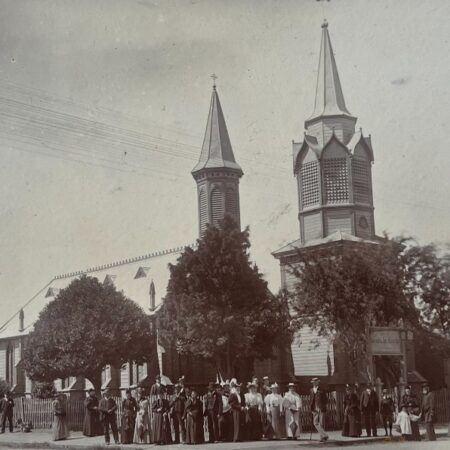
As I listened, I realised that we had a common predecessor: Rev Theodore Albert Meyer was both a curate at St Paul’s Anglican Church Papanui and a pastor at the Christchurch German Church—at the same time. He was actually from South Africa, but apparently from a German-speaking family. There he had trained at St Cyprian’s College in Bloemfontein and was ordained in the Anglican Church. He first served in New Zealand at Lincoln, before becoming the curate at St Paul’s Anglican in 1892. He was given particular responsibilities for Belfast, but also was in charge of St Paul’s while the various vicars pursued other callings and duties. Every second Sunday he would also hold two services at the German Church in the city. He later went to Woolston, remaining the Pastor at the German Church until he moved to Richmond (Nelson) in 1904. In later life he mainly ministered to Māori in the North Island.
In Christchurch the German church counted among its congregation some of the more prominent Canterbury families, such as von Haast, Tisch, Kippenberger, and Hansmann. They were involved in the life of the city and the country.
That was in stark contrast to the Lutheran communities in the North Island and Nelson, which consisted mainly of small farmers from Prussia and Scandinavian countries. Norsewood, settled by immigrants from Norway, is probably the most well-known of those. Many came to New Zealand via South Australia. They were hard-working, community-minded people, who worked the land. Pastor Mark Whitfield is descended from those Lutherans.
Shortly before his death, Pastor Mark Whitfield’s great-grandfather Gustav Hermann Nitschke wrote the following words to his children:
“Your sainted mother and I have had you brought up and instructed in the Christian faith. That is the best thing we have done for you; whatever else we have done for you is of no real importance. Now more than ever do I realise that great value of the Christian faith, and it is therefore my dying hope and prayer that you may continue steadfastly in this faith, and make the Kingdom of God your first concern, for it alone has abiding value …we have done for you what little we could.”